



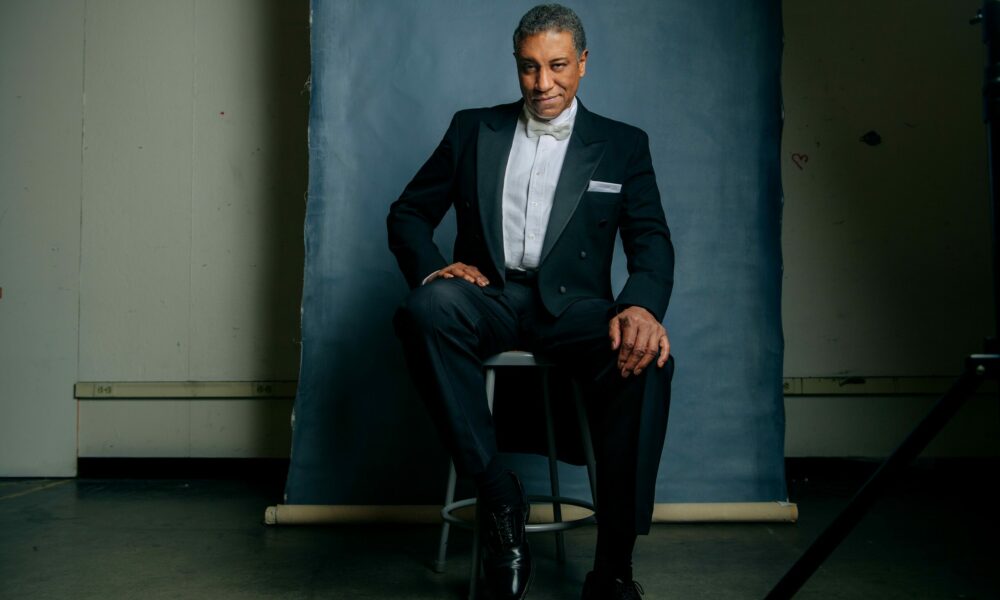
Today we’d like to introduce you to Mark Steven Doss.
Hi Mark, thanks for joining us today. We’d love for you to start by introducing yourself.
I grew up on the east side of Cleveland, Ohio. For most of my childhood, we lived next door to the rectory, school, and convent of Saint Edward’s parish on 69th and Woodland Avenue. Inspired by the priests and brothers of the Society of the Most Precious Blood, I had early aspirations of becoming a Catholic Priest, with the old Latin Mass still in my head and serving as an altar boy while attending St. Edward’s and two other Catholic Schools (St. Aloysius and St. Adelbert’s) before reaching the 5th grade.
It was then in the 5th grade at Dyke Elementary School that the music teacher had me sing (alone for her) the song from the Music Man, entitled “The Wells Fargo Wagon.” She said my voice was beautiful and that I could go to New York and make a lot of money. This scared me quite a bit, so it would be a while before I came back to music.
When I next entered Kennard Junior High School, my focus shifted to athletics, and excelling in basketball and track and field, I received the award for most outstanding athlete upon graduation.
After Kennard I went to East Technical High School, where the great Jessie Owens had once attended, and it was there that I finally began to excel at academics adding Spanish to the French I had taken in Junior High, doing quite well in chemistry and a College English prep class. At the same time, I expanded my athletic interests to include not just basketball but also baseball, tennis, and cross-country.
Music and drama were added in my 2nd year at East Tech when I discovered the two grades I had repeated in elementary level (mostly due to lack of attendance and shifting between so many schools) would cause me to be ineligible for sports in my senior year. So, my school counselor devised a plan for me to graduate from the 11th grade and taking Drama and Choir gave me the extra credits I needed to do that, as well as attending day and night school during my final summer.
Three major opportunities came from my drama and choir experiences, with the choir director asking me if I wanted to be a Super at Music Hall in downtown Cleveland for the Metropolitan Opera on Tour, in Verdi’s Aida. I agreed, went on stage, and I earned $8 for the night. Then the drama teacher asked if I would be interested in being in the musical Godspell, and saying yes, I had a great success with all the singing and dancing in that production. Finally, the band conductor, who led the orchestra of that musical was also the person who would be leading musicians from around Cleveland for the first-ever attempt to do a summer program dedicated to training students of diverse backgrounds in acting, singing, and dancing. This was and all facilitated on the campus of Tri C Community College. Almost two months of training ended with us putting on an original adaptation of The Wizard of Oz, called “The Wiz that Is.”
For the production of “The Wiz that Is” (on the theatre stage at Tri-C), we did 20 or more performances for the summer youth workers) and I played the lead character of Daniel Gale from Kansas. My dog, Toto, was a 6-foot-tall Polish guy, and the Wizard was a petite African American female. It was quite an example of DIVERSITY, and we thrived throughout the entire process. Meanwhile, I finished my summer schooling and graduated from high school, singing “There’s a Place for Us” from West Side Story for my graduating class.
In my final few months at East Tech, I was faced with some crucial decisions. Our basketball coach, John Chavers (who had been a member of the Globetrotters at one time) mentioned that with me leaving high school he could have written letters to get me on a college basketball team near Cleveland, but there was also a recruiter from West Point who showed interest in me, and at the same time my mentor and friend, Brother Hugh Henderson asked if I would be interested in entering the Catholic Seminary at St. Joseph’s College in Rensselaer, Indiana to study for the Catholic Priesthood. I fervently prayed about my decision, and I suppose that naturally led me to choose the seminary.
The voice coach from the summer program was a bit disappointed in my decision to pursue the priesthood, expressing his views that with all of my vocal talents I had a lot to offer the world. I assured him I would continue taking lessons when I was in the seminary, and I even sang in a production of The Man of La Mancha in my first year at St. Joe’s.
Disappointed with my social and spiritual journey in the seminary, I was given the idea by my second singing teacher (in my sophomore year) that if I decided to not continue in the seminary and I could become a professional singer if I worked very hard on my musicianship. Like Maria in the Sound of Music, I was being called to pursue another kind of life, and I began my journey onto that path entering graduate school at Indiana University’s School of Music in Bloomington, Indiana.
Earning my master’s degree at IU, I also sang 6 major opera roles while there, and I was about to enter the doctoral program after doing an apprenticeship with the Santa Fe Opera company and flying to Vienna to audition for their young artists program. But, while at the Santa Fe Opera Matthew Epstein (once the head of Columbia Artists Management) suggested he could put me into the finals of the Chicago Lyric Opera’s program, and if Vienna didn’t come through, I could start my training in Chicago instead. They did offer me a position at Lyric, and I never heard from Vienna, so I decided my doctoral degree would have to wait and I packed my things for Chicago.
I worked with very important singers and directors in Chicago, one of which was the stage director, Lotfi Monsouri, who offered me a job at the Canadian Opera Company in Toronto as Sparafucile in Rigoletto. I accepted, but being known for taking on extra duties whenever the opportunity arose, I filled in when a quick understudy was needed for the role of Manoah in Handel’s Samson. It was a joint production with the Met in New York and London’s Covent Garden, and not having a cover for Manoah, Jonathan Friend of the Met came to Chicago and heard me sing Manoah’s aria on the Lyric Opera stage. I was offered a Met contract, and the day after my ensemble contract ended at Lyric Opera I flew to New York to begin my first professional opera engagement at the Metropolitan Opera.
Ironically, before leaving Chicago I won a spot to compete later in New York as a National Semi-Finalist in the Metropolitan Opera National Auditions. This was also after I had just won the Grand Prize of the Bel Canto Competition (the prize I including a trip to study in Busseto, Italy with the noted tenor, Carlo Bergonzi. These three things all clashed, but I managed to have my cake and eat it too. The MET contract should have disqualified me from the competition, but because I never went on as a cover, my audition on the stage in Chicago earned me a honorary spot alongside the other Finalist Winners, and with the MET contract taking several weeks away from my Bel Canto trip to Italy, the Foundation (headed by the Monastero family) offered the unused funds for me to return to Italy to compete in the International Verdi Competition, which is what i did, winning the First Prize.
One part of the First Prize is an audition at La Scala, and though it took many years to happen, when it did, I sang the role of Escamillo in Buzet’s Carmen, and since I have sung SEVEN other major roles there. The height of my career could be singing the role of John the Baptist in Strauss’ Salome at La Scala, with the great conductor Lorin Maazel (who for many years conducted the Cleveland Orchestra) coming backstage after one of my performances to congratulate me! This also brought full circle my coming down the aisle in East Tech’s production of Godspell (as John the Baptist), singing “Prepare ye the Way of the Lord!”.
Can you talk to us a bit about the challenges and lessons you’ve learned along the way? Looking back, would you say it’s been easy or smooth in retrospect?
My musicianship has always been a struggle, so putting together a masterclass to prepare roles has been my trying to find more ways to listen to my own an advice. I’ve developed so many tools that I sometimes still get it wrong as to which ones I should use and when. I have had many opportunities concerning diversity, but unlike those who cast me as Daniel Gale from Kansas in that production of “The Wiz that Is”, not everyone has the same vision to see diversity as a positive element in casting. Travel is always difficult, especially these days, but I have somewhat gotten used to it.
Thanks for sharing that. So, maybe next you can tell us a bit more about your work?
Using the Stanislavsky method of bringing out words in each of the 10 languages I’ve sung in (103 performed opera roles/32 performed oratorio parts) has allowed my artistic creations to come off the page and inspire people. I research my roles very analytically, so not a lot is missed. My diction has been called the best on the planet, and I have many reviews that attest to that fact. Soaring and electrifying vocal acrobatics is hopefully a trademark I carry with me.
We’d love to hear about what you think about risk-taking.
Taking risks is a primary part of the business. When I audition, I am taking a risk and exposing myself to rejection, and when I’m performing I am exposing myself to the risk of the audience and/or the critics not liking my execution or interpretations.
I try to prepare everything I do with a sense that having accepted the risk, I have only to practice to go above and beyond what is expected of me. I don’t stop working after opening night, and one of the memorable lines I recall hearing backstage at La Scala during on of my performances was, “It’s getting BETTER!” That coming with the tone of astonishment because they knew it was very, very good to begin with.
Contact Info:
- Website: marksdoss.com
- Instagram: www.instagram.com/
marksdoss/ - Facebook: www.facebook.com/
Mark.S.Doss.Bass.Baritone
- Youtube: www.youtube.com/
marksdoss


Popular
-

The Change-Makers: stories that inspire
-

Hidden Gems: Local Businesses & Creatives You Should Know
-

Take Flight: Lamar Thomas on Building an Inclusive Brand Rooted in Youth, Community, and Purpose
-

Cultivating Inner Clarity: Angel Inspires on Thought, Healing, and Purpose
-

Local Highlighter Series
-

Highlighting Local Gems