



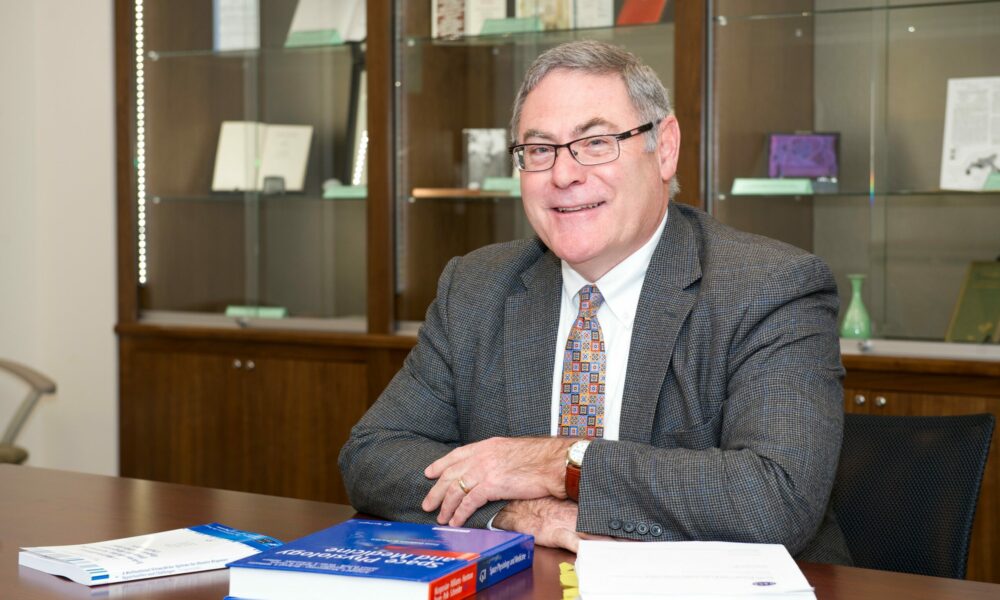
Today we’d like to introduce you to Charles Doarn.
Hi Charles, we’re thrilled to have a chance to learn your story today. So, before we get into specifics, maybe you can briefly walk us through how you got to where you are today.
When I was growing up, my parents took us to the Kennedy Space Center for summer vacation. It was 1968, and I was 11 years old. I got to see the mammoth Saturn V rocket being readied for launch to the moon. I was fascinated and thought it would be cool to work at NASA someday. When I was in high school, I set my sights on going to college and eventually medical school. I had the necessary tools and smarts; at least, I thought I was ready. So, after graduating from high school in 1975, I enrolled at The Ohio State University, where I embarked on the pre-med track. This is where I ran into the brick wall of chemistry and physics. I mostly struggled with the subject, as I was told I had to do well in these subjects in order to even apply to medical school. I mostly earn Cs, so I never applied. I eventually graduated with a BS in Biological Sciences, with a focus on Microbiology, and became a chemist for Ohio’s Department of Liquor Control. This was 1980.
Over the next several years, I started a family, which resulted in on son, Michael. He is an orthopedic surgeon now in the Tampa area and has wonderful wife and two children. After a few years of working at Battelle and, eventually, Hazelton Labs in Vienna, VA, I landed a great opportunity at the Wright Patterson Air Force Base in Dayton in the Toxic Hazards Unit. I got to see my son every other weekend, and I started an MBA. It was my great ambition that good science needed good management.
While earning my graduate degree, two seminal events occurred. One, I met my wife, and two, I became good friends with an individual whose father own and operated a contract at the NASA Johnson Space Center in Houston. After graduation, my wife and I moved to Houston, where I worked on the toxicology issues related to the Space Station Project. In less than a year, I became the contractor supervisor of the medical care facility for the Space Station Program. So here I am at the beginning of an illustrious career working with NASA and in medicine. This was 1990-1992.
In the fall of 1992, my wife and I moved to Washington, DC, where I worked at NASA Headquarters as a contractor. Soon, I became a faculty member in Wright State University’s Aerospace Medicine Residency Program and on loan to NASA. During this time, I was assigned several projects. The first was NASA’s international telemedicine efforts in Russian and eventually Ukraine (Spacebridge Projects), writing NASA’s strategic plan for telemedicine, the Space Medicine Program, and space medicine policy all the while serving as the program executive for aerospace medicine. This led to the authoring of NASA’s strategic plan for telemedicine in 1997 and the development of a Commercial Space Center (CSC) on Medical Informatics and Technology Applications (MITAC) at Yale University. By this time, my wife and I had two children, Christopher and Katelin, and we got to see Michael occasionally as he lived in the Columbus area with his mom and stepfather.
In 1999, my boss, the NASA Chief Medical Officer, insisted I go to Yale and address the challenges of running the CSC. This is when I became a faculty member in the Yale College of Medicine Department of Sugery. Within six months, we moved the MITAC from Yale to Virginia Commonwealth University (VCU) in Richmond. I was the executive director of MITAC at both academic centers. The PI was the chair of Surgery at both institutions. During the time at Yale and VCU, we conducted telemedicine experiments on Mt Everest, in Ecuador and other remote locations. We also developed a litany of invention disclosures, several spinoff companies, and wide range of peer-reviewed manuscripts in the scientific literature.
In 2003, I had the opportunity to move back to Ohio to take on the role of executive director of the Center for Surgical Innovation at the University of Cincinnati. During this past 20 years, I have served as associate and full professor. I was the director of MPH program, current director of the Space Research Institute for Discovery and Exploration (SRIDE), on loan to NASA as a special assistant to the Chief Health and Medical Officer, published seven books with several more under contract, and have written over 450 manuscripts, editorials, book chapters, and federal reports on telemedicine. During the past 30+ years I have traveled and lectured in more than 30 countries.
Can you talk to us a bit about the challenges and lessons you’ve learned along the way? Looking back, would you say it’s been easy or smooth in retrospect?
The road has not been smooth. I only have the BS and the MBA, and many people believe I am either physician or have a doctorate of some kind. So, politics have been a barrier every step of the way! My lesson learned here is be productive and willingness to accept both responsibilities and the challenges thrown your way. Being in the right place and the right time is also helpful!
Appreciate you sharing that. What else should we know about what you do?
Currently, I am the director of the University of Cincinnati’s Space Research Institute for Discovery and Exploration. I also am the editor-in-chief of the Telemedicine and e-Health Journal (since 2005) and serve as the special assistant to the NASA Chief Health and Medical Officer. I have been a Fulbright Specialist with the State Dept and have worked with NATO and the Department of Defense. I have been recognized world wide for my contributions in telemedicine and space medicine.
The legacy of the written word will outlive me, but the contributions are immeasurable!
What matters most to you? Why?
My family, my faith, and my reputation.
Family is the core of our existence. My three children are all very successful. They all have advance degrees. One is an MD/surgeon, the other two both have master’s degree – MPA and MFA. They have successful careers. Of course, none of this would be possible if it was not for my wife of 33, almost 34 years, Terri.
Contact Info:


Popular
-

Hidden Gems: Local Businesses & Creatives You Should Know
-

The Change-Makers: stories that inspire
-

Take Flight: Lamar Thomas on Building an Inclusive Brand Rooted in Youth, Community, and Purpose
-

Cultivating Inner Clarity: Angel Inspires on Thought, Healing, and Purpose
-
Local Highlighter Series
-

Highlighting Local Gems