



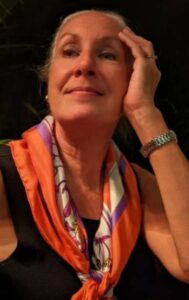
Today we’d like to introduce you to Margi Griebling-Haigh.
Hi Margi, it’s an honor to have you on the platform. Thanks for taking the time to share your story with us – to start, maybe you can share some of your backstories with our readers.
I’m a classically trained oboist, English hornist, and composer who hails from a unique family of composers. My father, Stephen Griebling (deceased), was a much-admired, self-taught composer who made his living as an engineer at Firestone Tire and Rubber in Akron; my mother, Mary Ann Griebling, was for several decades a very respected and successful private teacher of music theory, piano, and composition; my elder sister Karen Griebling, holds a DMA in composition and served for 30 years as a professor of music theory, composition, upper strings, music history, and world music at Hendrix College in Conway Arkansas. She also founded an orchestra at the school and has always been a huge over-achiever.
Coming as I do from these roots, it was inevitable that I should be exposed to a great deal of music as a small child. I was trained by my mother in music theory, took private piano lessons, and studied violin (rather unwillingly) for six years, eventually playing in a string quartet with my sister, who had become a violist. At age 7 and the youngest member of the Cleveland Orchestra Children’s Chorus, I was immersed in the sound of that great ensemble and fell in love with the English horn, the “big brother” of the oboe. It took two years of begging for the school system to allow me to begin oboe lessons, and when I finally started, it was an immediate love affair. I progressed pretty quickly and soon found myself studying with Harvey McGuire, the Cleveland Orchestra’s English horn player. My sister Karen was also studying viola with members of the orchestra, and before long we were both members of the University Circle Youth Orchestra (precursor to the Cleveland Orchestra Youth Orchestra) and the Akron Youth Symphony. I was quite fortunate to win concerto competitions with both groups, which was not a common occurrence for young oboists.
Meanwhile, the Akron Public Schools and the Akron Children’s Concert Society were offering (as they continue to do to this day) a unique-in-the-entire-country composition contest for school children from K-12. Students from each grade were invited to submit compositions in various categories; the higher the grade level the more categories there were: i.e., “solo instrumental,” “solo vocal,” “instrumental chamber music,” “choral,” “large ensemble,” etc. My sister and I submitted pieces in every category available year after year and often won prizes, to the point where we had a friendly competition for the largest number of certificates each season. This Scholastic Composers Contest was surely responsible for giving both of us the encouragement to continue to better our skills and expand our ambitions. Karen and I also entered competitions sponsored by the National Federation of Music Clubs, among other, and brought home many awards. Two of the most important of these for me were a BMI Award (Broadcast Music Inc.) and first prize in an NFMC orchestral competition which included a professional premiere.
All of this early positive reinforcement sent me on my way to conservatory for my college education. Truthfully, I had many other interests as a student at Firestone High School; these included biology, art, and French, and did feel a sense of regret about giving up these other possible courses of study, but music had me “hooked” and I could not turn away from it.
I attended Eastman School of Music as an oboe performance major, eschewing the offer to pursue a double major in composition. I simply did not enjoy the styles of composition that were being taught in the late 1970s and early 1980s and decided to keep my creative endeavors to myself, as it were. Most of my colleagues at ESM had no idea I was a composer until I presented a song cycle on my senior oboe (!) recital, playing the piano accompaniments for three soprano friends and doubtless really surprising the faculty committee.
I continued my studies at the San Francisco Conservatory of Music, receiving an MM in oboe performance but still composing at least as much as practicing. I then spent five summers at the Pierre Monteux Memorial School for conductors — playing vast quantities of repertoire in the orchestra there and even having a couple of compositions read by the conducting students. Throughout my career, I have always considered performing and composing to be of equal importance, with each skill strengthening the other.
I met my husband, First Assistant Principal Double Bassist in the Cleveland Orchestra Scott Haigh while attending summer concerts at Blossom Music Center. It was audience-to-stage eye contact over the course of several concerts until he finally introduced himself to me before an August 1984 performance. But I was moving to New York City the very next day, and so our friendship sat on the back burner and developed through letter writing for the next four years.
During the New York years, I made my living by hand copying music (pen-and-ink, like a medieval monk!) for many music publishers and composers. I had some talent in the realm of calligraphy, which was, after all, what music copying was until computer notation programs were developed at the end of the 1980s. I named my one-girl company “Musicalligraphics.” I eventually broke into the freelance scene as an oboist and English hornist, moved upstate to the Albany area, and became a member of the “orchestra of the interstate.”
I moved back to northeast Ohio in 1988, married Scott in 1989, and within two years, found myself joining the Cleveland Composers Guild (the oldest continuously functioning group of professional composers in the USA!). I immediately became an officer and seem to have been one ever since. I have served many terms as either secretary or chairman of the Guild and am currently in the second year of another term as chairman. In this capacity, and with the vote of the 40-some members of the Guild, I organize 5-6 concerts per season of music by the members in venues around northeast Ohio. The concerts are audio and video recorded, and most performances are later broadcast on a unique radio show called “Innovations” on Cleveland’s classical radio station, WCLV.
My association with many wonderful freelance musicians as well as the Cleveland Orchestra “family,” has earned me numerous commissions, mostly for chamber music. I have been extremely fortunate to have many fine performances and recordings of my works, which are now finding themselves all around the USA and to various other countries. I think my chamber music is now represented on 18 or 19 CD recordings, many of which were surprises (of the very best kind) to me! I have been asked to compose international competition pieces for piccolo, bassoon, and double bass; these pieces have certainly increased my reach.
My husband and I have one daughter, Gabrielle Haigh, who is successfully starting a career as a professional soprano. She, too, had remarkable early success as a composer, winning multiple ASCAP, BMI, and MTNA awards and having her first symphony (written at age 16) performed professionally by the Monterey (CA) Symphony Orchestra. Gaby earned her degree in Classics (Latin and Greek) at Cambridge University (UK) but was incredibly active as a soprano chorister and soloist in the world-renowned Clare College Choir. She has since gone on to earn an MM in voice/opera at San Francisco Conservatory of Music and is now equally at home singing opera, concert music, vocal chamber music, and art song.
Over the years, our musical family has always hosted chamber music parties, and about once each year, I have organized a professional chamber music concert, including some of my own music along with music by better-known composers. My goal going forward is to increase the numbers of these concerts, including performances as often as possible by my daughter, my husband, my sister, and myself, AND to gradually commit many of my lesser-performed works to professional recordings. My biggest ambition is to stage my opera — but that’s another story!
We all face challenges, but looking back, would you describe it as a relatively smooth road?
Being a professional classical musician in NEVER a smooth road. The field is incredibly competitive, especially for some orchestral instruments. Conservatories turn out far many more musicians than can ever hope to win auditions since openings in orchestras that pay a living wage are few and far between. I took my fair share of screened auditions in the 1980s and reached the final round in two of them, which encouraged me to keep trying. However (as an example of the level of competition) at one audition for third oboe, 120 musicians were heard, and nobody was selected. I, of course, was acquainted with a fair number of my fellow competitors, all of which were recent graduates of prestigious conservatories!
My marriage and return to northeast Ohio sealed my fate as far as future auditions were concerned; at that point, I had committed to staying in the area since my husband’s job was unbeatable and secure. However, the freelance scene in the area was not robust, and oboe positions in the local orchestras were already filled. The best I could hope for were substitute or extra gigs, and for a while, my best work was done as a substitute English hornist in the Erie (PA) Philharmonic.
As a composer with no degree in composition, I have also had to forge my own path. I have no regrets about this because I have enjoyed the freedom to write exactly how and what I want. The downside of this is not having a position within any of the local schools of music, which would have provided the benefit of many performance opportunities. What this has meant is that each relationship with individual musicians, chamber groups, or the occasional larger ensemble has been cultivated by me without much external support.
My involvement with the Cleveland Composers Guild has therefore been an extremely valuable resource in terms of networking and having a couple of pieces performed to a high standard each season. Through my performing friends’ word has gradually trickled out during the past four decades, and I’m enjoying more and more exposure. It seems like performers and audience members alike really do like my music!
Thanks for sharing that. So, maybe next you can tell us a bit more about your work?
As a classical composer, I strive to connect with performers and audience members by writing in an honest and yet adventurous style. My music has been characterized as whimsical, nostalgic, lyrical, and humorous. I believe quite strongly that music must have its own architecture; it needs form in order to function. Elements of the music must be almost immediately memorable so that when an audience member hears a piece for the second time, he or she can say, “Aha! This seems familiar!”
I’m proud of the recognizability of my music, and performers who have worked with me have acknowledged that I have developed a unique personal style and musical language.
As a performer myself, I am acutely aware of what performers need in order to succeed in presenting new music. This includes careful and correct notation, helpful cues, page turns provided for, and other such practical elements. My long-standing career as a music copyist and editor has given me a lot of experience in these matters.
I often write music that is based on imagery from travels, and I’ve composed quite a number of narrated stories with colorful chamber music accompaniments. I have a long-standing love of the poetry of Edna St. Vincent Millay and have written about twenty art songs to her lyrics. I’m also likely to hide musically encoded names and dates in my music, although this is rarely something any listener would pick up on.
If you had to, what characteristic of yours would you give the most credit to?
I’m an efficient and organized person, which is probably why I continue to be elected to serve as an officer in the Cleveland Composers Guild, among other organizations. It’s one thing to have imagination and creative talent, but these things cannot survive in a vacuum! It takes quite a bit of follow-through to make connections with other musicians and to organize and promote events. I have spent my life on both sides: first creating new music and then finding ways to have my own music as well as that of my friends and colleagues heard.
Contact Info:
- Website: musicalligraphics.com
- Youtube: www.YouTube.com/channel/UCBqzpEQn6WAn0JNufCC2aDg

Image Credits
Casse-Tête
North Coast Woodwind Quintet
Popular
-

The Change-Makers: stories that inspire
-

Hidden Gems: Local Businesses & Creatives You Should Know
-

Portraits of Ohio
-

Take Flight: Lamar Thomas on Building an Inclusive Brand Rooted in Youth, Community, and Purpose
-

Cultivating Inner Clarity: Angel Inspires on Thought, Healing, and Purpose
-

Local Highlighter Series