



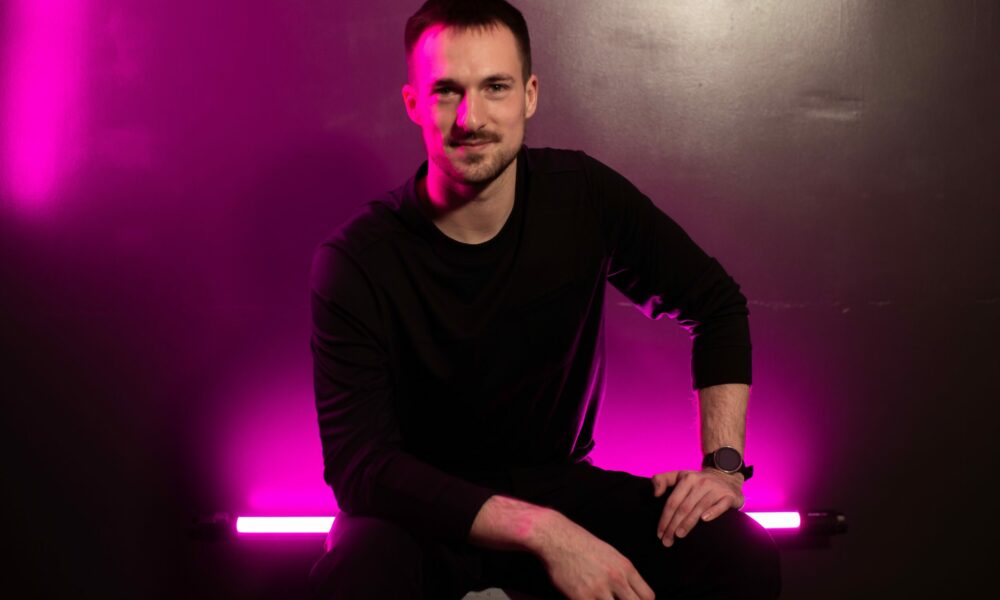
Today we’d like to introduce you to Daniel Scheid.
Alright, so thank you so much for sharing your story and insight with our readers. To kick things off, can you tell us a bit about how you got started?
Essentially, everything in my current trajectory began when I was a Jr. in Highschool, and one of our long-time family friends asked me to come help clean the Audio production shop he worked at, Access Audio. Like every kid of that age, I had recently started driving. and so, I’d take whatever money I could get. Apparently, I was proficient enough to keep around, and eventually, I started getting asked to help on audio gigs moving gear, and driving trucks. I didn’t know very much (basically anything) about live production, but quickly I found out that most people who did had one particular skill set that really set them apart from everyone else. They knew the features of the gear they were working with Inside and out, and could combine the functionalities of different pieces of equipment to make outside-the-box cool productions. This usually entailed a dedicated couple weeks of deep-dive learning every time a new piece of gear like a lighting fixture or video board was released. While I am currently still involved in with Access Audio, my main passion has shifted from live production to musculoskeletal medicine and human performance. However, the foundational approach of learning tools inside out and then combining them in creative ways to produce high quality and unique problem solving is at the core of what keeps me going.
We all face challenges, but looking back would you describe it as a relatively smooth road?
Not even a little. One of the main reasons I am no longer in the engineering/technology sector full time is because I was forced to make some pretty significant life alterations early in undergrad. I have a long family history of service in the military, and it has been one of my goals since an early age to follow in their footsteps in some capacity. So, at the beginning of my undergraduate career, I declared an Electrical Engineering Major with a minor in Biomedical Science and Joined Air Force ROTC. I’m not going to lie, I was really happy with this choice and pursued it wholeheartedly because the Air Force is a phenomenal organization with some of the best people on the planet. However, I ended up getting medically disqualified from serving in any capacity that I would enjoy due to some previous complications with out-of-country travel. This essentially upended every plan that I had been working on for myself and really catalyzed a significant need to re-calibrate and see what the options were now that all of my current dreams were unattainable.
This is definitely a weak sauce reason for joining the Physical Therapy profession, but it basically came down to the fact that I really liked people, and was pretty good as science. That was the majority of what my life-altering change hinged on post Air Force and Engineering.
Thank goodness everything happened the way it did though because the re-evaluation process was extremely valuable, and it has given me the skill sets necessary to set a plan B and C for almost every situation and be very agile any number of insane and unpredictable situation that tend to come with just being a human.
Appreciate you sharing that. What else should we know about what you do?
I do a lot of things, and absolutely love every single one of them. In order to keep progressing in this space, it will be necessary to hold some significance academic credentials at some point, and so I am a Physical Therapy student at the University of Cincinnati by day. This is an amazing profession, and I really can’t wait to start practicing after graduation. However, right now the things that really give me life are what go on after school and on the weekends.
My main pursuit currently is a straight-up dream job. About a year ago, I met my now fiancé and both commiserated over how we thought the performing arts was grossly lacking in the order of resources and education in health and physical wellness. She was coming off of performing in New York, and I was finishing up a research assistantship with UC Athletics. Her family owns Moss Performing Arts Academy in Ft. Wright Ky, and so we realized that the best place to enact the changes that we wanted to see was at the very beginning stages of young performers’ development through Moss. A subsidiary of Moss called Stage Fit was born, and between our two skillsets we have been able to build out one of the most unique athletic development and performing arts training groups in the nation. We are able to make such an amazing impact on our kids’ lives, and being able to do all of it together with coolest girl on the planet is way more than anyone could ever ask for.
In addition, I have had the absolute pleasure to be a co-founder of a Non-Profit Adapted Strength and Conditioning group called Iron Core. Very similarly to Stage Fit, Iron Core started because we saw a significant gap in the access to athletics development opportunities adapted athletes had outside of their traditional sports. On the flip side, as students in health sciences we also saw a gap in the exposure we were afforded through traditional schooling to work with this somewhat niche population. So, we created a program that pairs university allied health students with adapted athletes. The students create a strength and conditioning plan for their assigned athlete and work with them through a traditional 6-week conditioning cycle. This not only gives the athletes access to strength and conditioning, but also access to their friends and teammates in an additional setting besides just their sport. Admittedly I am much more involved in the administration than the coaching at Iron core, but in my totally nonbiased opinion, it is one of the coolest experiences that any health science student will have throughout their whole undergraduate career.
Lastly, I am involved with a group called Fitopia EMS, which is the first Electromyostimulation studio in the Cincinnati area. Because of my skillset, I specialize in working with special populations that need additional care above what a traditional personal trainer or strength coach would offer. It is a really cool blend of technology and human performance, and I think within the next 5-10 years this will be a very viable solution to making exercise possible for a wide range of conditions that are currently limited by their ability to generate volitional movement.
What has been the most important lesson you’ve learned along your journey?
How seemingly unrelated things can almost always be connected. Because I was able to work for Access audio, I it gave me the skillset to learn technologic tools. Does an operating a video switcher have very much to do with human performance? Not at first glance, but does the learning process afford me a mastery of the vast array of new performance technologies on the market? Absolutely. This allows me to provide top-tier guidance on improving the health and athletic performance of every one of my clients, age 8 to 80. I think this gives me a pretty good edge above the vast majority of other health and wellness professionals, and it can really be pretty directly attributed to making connections between things that are seemingly unrelated.
Contact Info:
- Email: stagefitbymoss@gmail.com, dscheidservices@gmail.com
- Website: https://www.mossdanceandperformingartsacademy.com/, https://www.ironcorefitness.org/, https://fitopiaems.com/
- Instagram: https://www.instagram.com/stagefitbymoss/, https://www.instagram.com/iron.core.fitness/, https://www.instagram.com/fitopiaems/


Popular
-

The Change-Makers: stories that inspire
-

Take Flight: Lamar Thomas on Building an Inclusive Brand Rooted in Youth, Community, and Purpose
-

Cultivating Inner Clarity: Angel Inspires on Thought, Healing, and Purpose
-

Local Highlighter Series
-

Highlighting Local Gems
-

Hidden Gems: Local Businesses & Creatives You Should Know