Today we’d like to introduce you to Andrew Cook.
Andrew, we appreciate you taking the time to share your story with us today. Where does your story begin?
I honestly never thought I would end up an entrepreneur. I dropped out of a nursing college program to join the Navy (retired in 2017), and at that point I felt pretty lost and needed a break. Some people take a gap year, I ended up in bootcamp to avoid having to figure out what would come next in life. Once the shock wore off, I quickly figured out that the military was a system I could benefit from. It clicked with me, and I figured I would be in for the long haul. Eight years later I had a supervisor who was encouraging us to knock out some college credits at the Navy College office, and I learned about a program from Southern Illinois University that flew professors from the Carbondale campus out to teach college classes on the weekend. I think there were two different degree programs available, and the Workforce Education and Development program caught my eye. This was my first real exposure to HR. Not long after graduating I joined the reserves and started a civilian career in HR. First in higher education and then, after using that opportunity to obtain two master’s degrees, I found myself working at a non-profit and fell in love with that sense of mission. In my military career, I was picked up for an officer program as an intelligence officer, and then returned to active duty for four years working in recruiting. Recruiting made sense to me. It blended my love for my military service with my HR experience.
After leaving my tour with recruiting, I went back to my non-profit work, but stepped into a new role in that transition. I still oversaw HR, but took on leadership in several other departments as well. It was more of an administrative operations role, and while I liked the work and enjoyed the new challenges, I needed to take a step back and become more directly involved with my family and the daily logistics of child care. I moved into another operations role closer to home and enjoyed that work for the next seven years. I was most proud of the work we did to keep that business open, with no layoffs, through Covid.
I left that role to take on a remote position acting as a fractional COO for tech startups that were graduating out of Y Combinator. While that was interesting work, it ultimately felt hollow. I wasn’t feeling connected to any specific mission, and I often felt more like tech support than part of a team. But that really got the wheels turning for me. That kind of fractional support work had value. There was a way to be part of a team, love the missions I served, and give small businesses an advantage. And then it clicked.
Years ago, my wife and I noticed that restaurants we loved would suddenly close up. Things looked normal one day, and then the following week we would be headed to dinner and show up to a locked door. We always wondered what happened in those situations. How does a business have steady customers and then fails out of the blue? It felt like there was something we were missing. Some piece of the puzzle we couldn’t see. I had this conversation with a friend, and he said that he (a business owner) believes that people start a business for one of three reasons.
1) They have a passion. I always think of someone that loves to bake cupcakes. Everyone rants about them, they love it, family and friends hire them to bake for birthdays and they think “This would be a pretty sweet gig to do what I love and get paid. People already like what I have to offer!” Boom. You open a cupcake shop.
2) You do something really well and are willing to bet on yourself. This probably describes where I fall into the three categories. I’m good at what I do and I was willing to bet that I could deliver.
3) You aren’t passionate and you don’t know the business, but on paper all the numbers look good. I spent some time looking at franchise opportunities, and if I had gone down that road, this would have been me.
The thing is, you can start a business for any of those three reasons, and you find out (probably on your first day) that there is a ton of stuff that you don’t know. Because a cupcake business isn’t just about cute frosting decorations. Now you have to manage inventory, scale up operations, figure out how to manage supply and demand, get a tax ID, figure out what happens when you aren’t feeling well and need to take the day off, record all of your business transactions and balance the books. The list goes on and on.
While not having enough operating capital is the number one reason businesses close, number two boils down to not having the experience to run a business. This is where I see my mission. I give small business owners a piece of my experience so they don’t have to try and learn everything the hard way while there are plenty of other plates to spin. Most people get an accountant, an attorney, and maybe IT support right out of the gate, but it isn’t long before people, policies, payroll, benefits, and compliance become issues. HR is a place where people think “I know how to handle people,” and they don’t know what they don’t know.
So I’ve been in business for three years and have served clients coast to coast. My longest client has been with me from day one. I’ve had an awesome opportunity to see how their situation changed from a stressed out owner wearing lots of hats, to an owner with a manager that he was training, to a manager that is today running the majority of the business in a stable and profitable way while the owner works remotely. We got there through people, processes, and plans. That excites me.
Alright, so let’s dig a little deeper into the story – has it been an easy path overall and if not, what were the challenges you’ve had to overcome?
No. I think the biggest struggle along the way was all the anxiety about whether this adventure would be enough. Would it pay the bills, yes, but also would it feel like I was doing some good in the world.
The whole journey essentially started with me feeling overwhelmed and unsure of where I was supposed to be heading. Honestly, I bounce in and out of that frame of mind a lot. That is a byproduct of comparing other peoples’ “outsides” to my “insides.” People look put together on the outside. Even before modern social media allowed a hyper-cultivated story to be told, people always tried to keep up with the neighbors. At least what they could see of them. Inside our head, and seeing all the nooks and crannies of our lives always feels like a hot mess comparatively.
These days I remind myself that the journey is more important than the destination, and that we never know what others are dealing with. That has given me a reminder to just chill out when I start to feel like things aren’t ok.
Alright, so let’s switch gears a bit and talk business. What should we know?
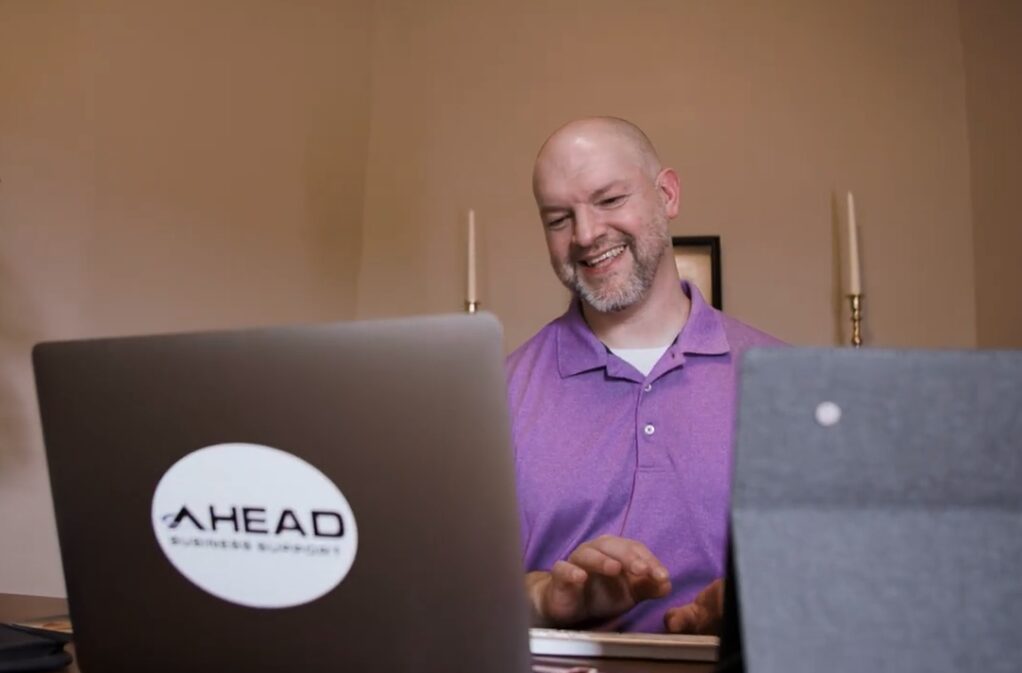
Ahead Business Support helps Ohio business owners feel confident and supported as their businesses grow.
We work with small and mid-sized businesses that reach a point where running the business starts to feel heavier and more complicated than expected. Often, our clients are excellent at their craft but find themselves overwhelmed by administrative responsibilities, people management, or uncertainty around whether they are doing things the right way. That uncertainty can create stress, hesitation, and a sense that one mistake could have real consequences.
What we do is bring clarity and structure to that stage of growth. We help business owners move from informal, reactive systems to thoughtful, well-supported operations so decisions feel calmer, safer, and more intentional. Our work is outcome-focused and centered on reducing anxiety, creating efficiency, and giving owners the confidence to step fully into their role instead of carrying everything themselves.
What sets Ahead Business Support apart is our approach. We believe that process should serve the business, not the other way around. Rather than forcing clients into rigid systems, we take the time to understand how their business actually works and what they want it to become. From there, we build support that fits. When something cannot be done exactly as envisioned, we are direct and transparent about why, and we help clients find the best possible alternative without creating unnecessary risk.
Brand-wise, what we are most proud of is the trust our clients place in us. Many come to us feeling unsure or worried that they have already made mistakes they cannot undo. Over time, they tell us the biggest change is not just cost savings or improved processes. It is peace of mind. They finally feel steady again. They feel supported. And they feel confident making decisions because they know someone is watching their back.
What we want readers to know is this. Feeling overwhelmed does not mean you are failing. It usually means your business is growing. Ahead Business Support exists to help Ohio business owners navigate that growth with clarity, confidence, and far less stress.
Is there any advice you’d like to share with our readers who might just be starting out?
One of the biggest things I wish I had understood earlier is how quickly “everything is fine” can turn into “this is overwhelming.” When I first started out, I assumed I could just wing it because I was good at thinking on my feet. That works for a while. But even small growth, like going from a few clients to a handful more, can suddenly expose how chaotic things really are. I did not fully appreciate how close together stability and overload can be.
What surprised me most was how personal it all felt. I had managed businesses for years, but they were always someone else’s. When it is your business, it can start to feel like something you need to constantly protect and control. Those instincts are natural, but they can also keep you from letting the business grow in a healthy way.
If I could go back, I would tell myself to give the business permission to grow and develop without hovering over every detail. Trusting that you have put the right structure and support in place can save a lot of restless nights.
I also no longer believe the idea that anyone is truly self-made. Every successful business is built with the help of other people, whether that is mentors, team members, advisors, or partners. Thinking you have to do everything alone, or that you should already know everything, only makes the journey harder.
My most practical advice is to be clear about what actually matters. Ask yourself whether the process is important or the outcome is important. If the outcome matters and you try to control the process, you will burn yourself out and limit the people around you. If the process matters and you try to control the outcome, you will create frustration. Control what truly matters and let go of the rest.
And finally, you are not behind just because someone else is in a different place in their journey. Comparison creates unnecessary pressure. Every business grows on its own timeline.
Contact Info:
- Website: https://aheadsupport.com/
- LinkedIn: https://www.linkedin.com/in/aheadhrsupport