



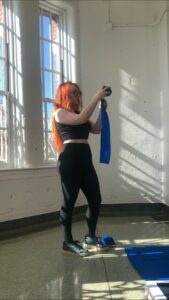
 Today we’d like to introduce you to Kelly A. Hanning.
Hi Kelly, so excited to have you on the platform. So before we get into questions about your work life, maybe you can bring our readers up to speed on your story and how you got to where you are today.
I think it would be safe to say I came out of the womb making art! My dad’s mom, I call her Mema, is a painter. She taught me how to paint! I used to spend at least a week every summer with my grandparents, cooking together, painting, and sometimes even a little clay sculpting! That is actually where I am now! But I was always made from a young age.
My mom and I used to build paper sculptures when I was in elementary school. Our most ambitious project was building a scale model of Goddard from Jimmy Neutron! Once I got a little older though, I sort of nestled myself into 2D. I did a lot of portraits in high school, mostly the charcoal work of musicians. They were good as studies, but I was glad Mema taught me a lesson about copyrighted reference images before I applied to college!
I ended up going to Florida State University in 2014 and eventually getting into the BFA program there. That was where I got heavy into oil painting! In around 2015 or so I took my first class with the amazing Carrie Ann Baade, which was the color theory. I had written a paper about her my freshman year so it was safe to say I was and am a fan. But she opened me up to the alchemy of paint, it is truly part-magic part-chemistry.
I was super lucky to go through such a technique-focused school. I didn’t only learn to wrangle the paint surface though, I got focused too on the viewpoint of the audience and how you can elicit more specific experiences by adding an installation or interactive element to a 2D work. I think that sort of unique experience of having that rigid technical instruction paired with the freedom of experimentation was what got me into more installation projects that have painted elements.
I always say when I’m conceiving an idea that I have to find the right medium to communicate it with. Not every idea should be a painting, and not every idea should be an installation–sometimes the idea needs to be born as both or neither or both and a performance! I’m sure not everyone would agree with that, but I’m a maximalist so I’m not scared of being called tacky.
After graduating, I took a quick break from school to make ten big old paintings (really about seven good ones and three bad ones), plan my wedding, and move to Ohio. This was all in about six months! When I moved up here, I spent my first three years in the grad program at Ohio University. I got a lot of experience there that I am truly so lucky to have! I got to teach for three semesters, some of them multi-section classes.
I loved teaching there, I am so proud of all of my students! Some of them are already in grad school! I also worked with the education team for the Kennedy Museum of Art under Sally Delgado, who taught me so much about professionalism and being a working artist. While at OU, I also was lucky enough to be a studio assistant for some amazing projects. I did some carpentry work for John Sabraw’s acid mine drainage reclaim and put my waders on a few times to help reclaim too!
I was also lucky enough to paint one of the sets for Bjork’s Cornucopia tour under Broooks Wenzel. I think those jobs helped propel me into the more fabrication-based jobs I took when I moved to Columbus. I did some character fabrication for the Scarefactory, as well as some for Otherworld (both in Columbus and Philadelphia). Now I’m teaching at CCAD and getting back more into my painting roots!
I’m sure you wouldn’t say it’s been obstacle free, but so far would you say the journey have been a fairly smooth road?
I don’t think smooth is the right word! Being an artist is not an easy career path. There is no clear-cut list of steps you can follow to become successful. You have to have the motivation to keep getting rejected until you’ve found what you define as success. Even then, no opportunity lasts forever, so you have to keep adapting and finding those windows when doors close.
I think to move forward you need to be able to face harsh criticism and accept it when it’s true. While I am my own harshest critic, I’ve been lucky enough to have some brutally honest mentors. I feel like I sort of keep them all in the back of my head when I’m working like they’re my pack of ghost Jedis following me around all the time!
That makes it easier to keep pushing myself forward, but I think the biggest struggle is balancing making enough money and finding the time for your practice. I have about six I-9’s coming to me at the end of the year, but I don’t think I made enough art! Next year I’m looking forward to cooling it down a little and working on much more of my practice.
Can you tell our readers more about what you do and what you think sets you apart from others?
I think the things people most recognize about my work, which carry through every medium I work in, are the levels of detail and my color palettes. No matter how big a piece is, I will do detail down to the last millimeter. I don’t know how many square feet of canvas I’ve covered in wood grain, grass, and shag carpet, all with a brush no thicker than my pinky nail. I think that’s a crucial part of my process, having the time to sit with a piece doing a repetitive motion for hours on end.
It’s awful for my back and neck, but it allows me time to meditate on the concept and the narrative. The detail also encourages people to sit with a piece longer. My favorite part of viewer interaction is when they find a hidden detail. It’s such a nice moment of connection when somebody spends enough time with a piece that they find something no one else does. It’s like I painted that part just for them!
The color palettes contribute to that viewer connection too. I try to avoid using white or black not just in paintings, but in all of my work, because of the way it can mimic the way our eyes perceive color. We have blue, green, and red cones in our eyes, so why would I take away from that richness of color by adding a ton of white or black? That’s part of what sucks people into the big paintings especially, the consideration towards color makes it seem a little more alive.
Any big plans?
I think I’m done with changes for a while! I’ve had such a whirlwind the past ten years, now I’m in my late 20s and I’d like to get back into the world. I feel like I’ve been in my little closet making art for so long, now I need to get out and experience life until I have enough inspiration to lock myself back in.
Next semester I’m teaching Studio Art Entrepreneurship at Columbus College of Art & Design, so I’m looking forward to focusing on my students without the distraction of another full-time job on top of teaching.
Contact Info:
- Website: https://linktr.ee/Kelly_a_hanning_art
- Instagram: https://www.instagram.com/kelly_a_hanning_art/?hl=en


Image Credits
Harley Jane Wince
Popular
-

Hidden Gems: Local Businesses & Creatives You Should Know
-

The Change-Makers: stories that inspire
-

Take Flight: Lamar Thomas on Building an Inclusive Brand Rooted in Youth, Community, and Purpose
-

Cultivating Inner Clarity: Angel Inspires on Thought, Healing, and Purpose
-

Local Highlighter Series
-

Highlighting Local Gems